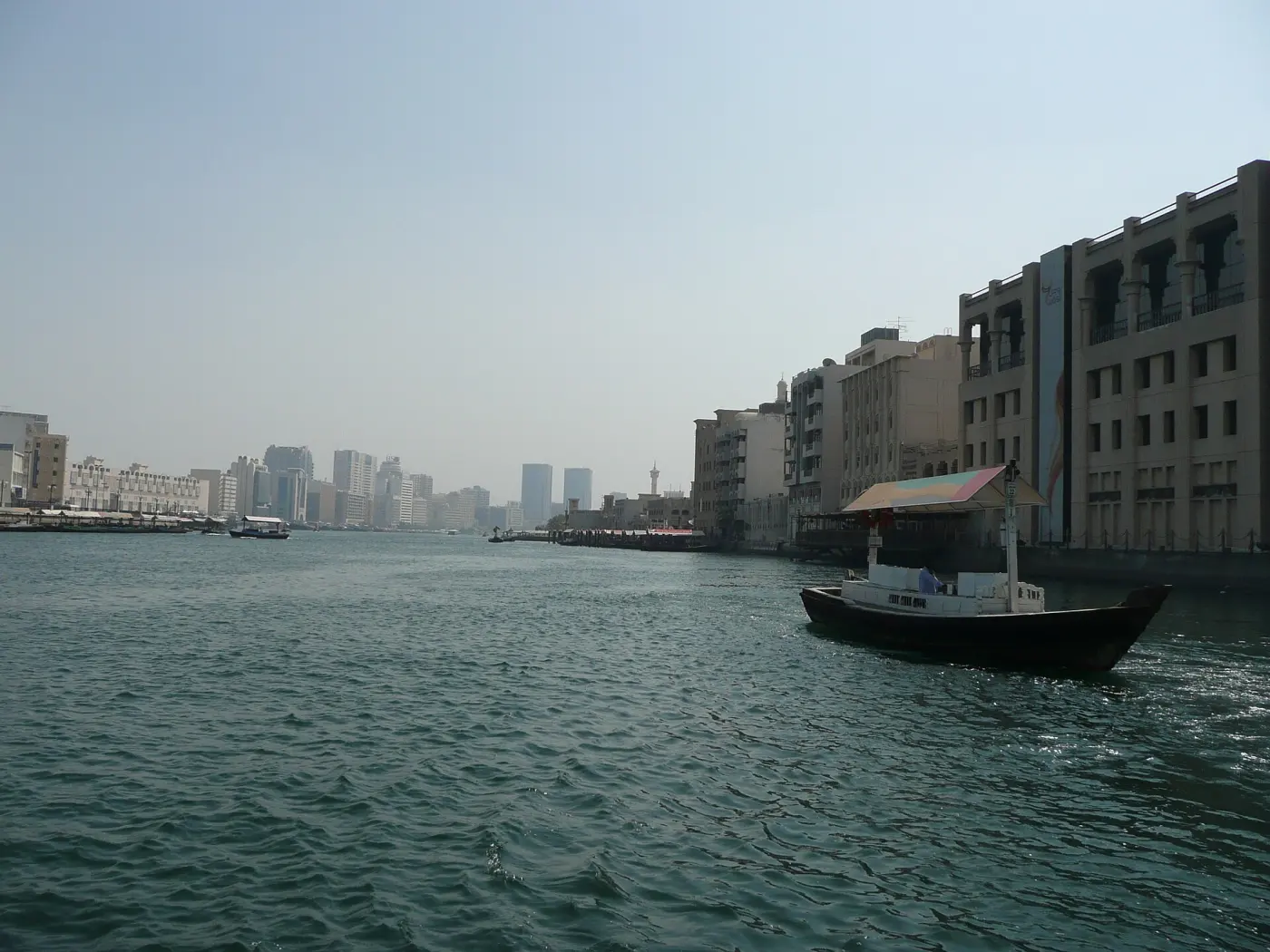
The Dubai Creek Abra: Cheapest Boat Ride in the City
For around one dirham, you can step onto a wooden boat, sit shoulder to shoulder with traders, tourists and delivery guys, and cross the water that Dubai was built on. The Dubai Creek abra is not a tour. It is public transport that happens to be a postcard.
This guide covers how it works, which station to pick, what to bring (coins, mostly) and how to turn a five-minute crossing into a proper afternoon between the souks.
- Fare
- Around AED 1 per person, per crossing
- Payment
- Cash to the driver; carry coins
- Crossing time
- Roughly 5 to 10 minutes
- Hours
- Early morning to around midnight (check RTA)
- Best time
- Late afternoon to sunset, October to April
- Main route
- Bur Dubai side to Deira Old Souk side
Top photo: CT Cooper, Public domain, via Wikimedia Commons (see credits).
What an abra actually is
An abra is a traditional wooden water taxi, low and flat, with a canopy overhead and bench seats running down the middle. The driver sits at the back with the engine. Passengers sit back to back, facing out over the water, which is exactly why the view works so well.
The Creek is a saltwater inlet that cuts through the old part of Dubai, separating Deira on one side from Bur Dubai on the other. Before the bridges and tunnels, boats were how people, goods and gold moved between the two. The abras are still doing that job, and plenty of workers use them daily to skip traffic on the road bridges.
Each boat holds roughly 20 passengers. That is not a luxury cruise. It is a bench, a breeze and a view of dhows stacked with cargo.
How the crossing works, step by step
There is no ticket booth and no timetable to memorise. You walk to the abra station, find a boat that is loading, and climb aboard. The boat leaves when it is reasonably full, so on a quiet afternoon you may wait a few minutes, and at rush hour you may barely have time to sit.
Once the boat is moving, the driver or an assistant collects the fare. It is around AED 1 per person and cash is the safe assumption. Hand over a coin, not a large note. Nobody will be thrilled to break a AED 100 note for a one dirham ride, and you will feel it in the vibe.
The crossing itself takes roughly 5 to 10 minutes depending on route and traffic on the water. Step off carefully when the boat touches the dock; the gap and the boat's movement catch out more first-timers than the water does.
Fares, hours and payment options can change, so check the RTA (Roads and Transport Authority) website or app for the current position before you plan around them.
Which station should you use?
The classic pairing is the Bur Dubai abra station and the Deira Old Souk station. Both are in the heritage core, both are walkable to major souks, and the crossing between them is the one most people mean when they say "the abra".
On the Bur Dubai side, you are next to the Textile Souk, with its covered lanes of fabric, pashminas, souvenirs and men who say "Madam, special price" from three shops away. The Al Fahidi historical neighbourhood, with its wind-tower houses and small galleries, is a short walk inland, and the Al Seef promenade, a newer heritage-style strip with cafes, is along the waterfront.
On the Deira side, the Old Souk station puts you close to the Gold Souk and the Spice Souk. You can be looking at a shop window full of gold necklaces within minutes of stepping off the boat. There are other stations along the Creek too, and some routes run between different pairs of stops, so look at the signs at the dock or check the RTA map if you want something specific.
If you are not sure, board the nearest abra and ask the driver where it is going. They answer this question about forty times a day and have made peace with it.
Turning it into an afternoon
The easiest loop starts in Bur Dubai. Wander the Textile Souk and the Al Fahidi area, grab a karak tea or a simple lunch, then walk to the station and cross to Deira. From there, browse the Spice Souk, see the Gold Souk, and cross back at sunset when the light on the water is softer and the heat has dropped.
Some practical points make it much better:
- Bring coins for each crossing, and a few extra in case you go back and forth.
- Wear shoes you can walk in; the souks are mostly on foot and the pavements are uneven in places.
- Carry water, especially from May to September, when midday on the Creek is properly hot.
- Keep your phone in hand for photos but your bag closed; the boat is stable, but the dock is busy.
The souks are bargaining territory. In the Gold Souk, gold is usually priced by weight with a making charge on top, so compare a few shops before you commit and ask for the day's rate. In the Textile Souk, a friendly counteroffer and a smile will take you further than a hard stare.
If you want a quieter side of the Creek, the water leads out toward Ras Al Khor, where flamingos feed on the mudflats in the cooler months. You will not get there by abra, but the Ras Al Khor Wildlife Sanctuary is a good contrast to the souk bustle if you have another half day.
Private abra rides and what to watch for
Besides the public crossing, you will see drivers offering a private ride along the Creek. These are usually priced per boat per hour rather than per person, and commonly quoted figures are around AED 100 an hour, though rates vary and are often negotiable. Treat that as a rough guide and check current prices.
A private ride is a different product. You get a longer route, more time for photos and a chance to chat with the driver, who may point out landmarks. If you do one, agree on the price, the duration and the route before you step on board, and pay at the end rather than upfront.
If you only want the local experience, you do not need this. The shared public crossing is the real thing. If you are with a group or want a slower look at the old buildings and dhows, a private ride can justify itself.
Do not confuse the abra with the dhow cruises, which are dinner boats with set menus and a different price tag. They are fun in their own way, but they are an evening outing, not a way to get across the water.
Is it worth it?
Yes, with realistic expectations. The abra crossing is short, a little bumpy, and you will share it with strangers. It is not a scenic cruise and it will not take more than a few minutes of your day.
What you get is a very Dubai moment for next to nothing: wind on your face, old dhows close enough to touch, and the sense that this city had a life before the skyscrapers. It also makes the route between the Textile Souk and the Gold Souk faster and a lot more interesting than the road.
If you are short on time, cross once each way and treat it as part of your souk walk. If you hate heat or crowds, go in the late afternoon or on a cooler day and skip midday. If you want a longer boat experience, pay for a private ride or a dhow cruise instead. For one dirham, though, it is the best-value thing on the Creek.
Quick answers
How much does the Dubai Creek abra cost?
Around AED 1 per person for a standard public crossing, paid in cash to the driver. Fares can change, so check the RTA for the current price.
Where do you catch the abra in Dubai?
The best-known crossing links the Bur Dubai abra station with the Deira Old Souk station. Other stations along the Creek serve different routes, so check signs at the dock or the RTA map.
What time do abras run?
Roughly from early morning until around midnight, with the busiest times in the evening. Check the RTA for current operating hours.
Can I hire a private abra?
Yes. Drivers offer private Creek rides, typically priced per boat per hour (commonly around AED 100, but check current prices). Agree on the price, route and duration before boarding.
Want more wildlife after the souks? Head to the Ras Al Khor Wildlife Sanctuary for flamingos at the end of the Creek, or try the Al Mamzar Beach for a swim.